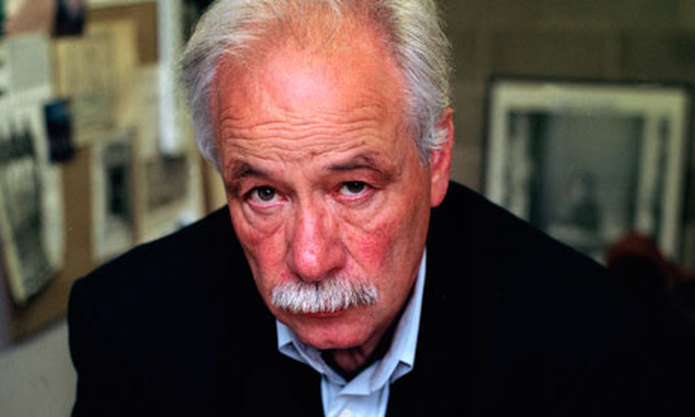
"W.G. Sebald taught his final fiction workshop at the University of East Anglia during the autumn of 2001. In the literary world he was rapidly gaining renown: there had been the succès d’estime of his first three books, and then the publication of Austerlitz earlier that year. In the classroom—where David Lambert and I were two of sixteen students—Sebald was unassuming, almost shy, and asked that we call him Max. When discussing students’ work he was anecdotal and associative, more storyteller than technician. He had weary eyes that made it tempting to identify him with the melancholy narrators of his books, but he also had a gentle amiability and wry sense of humour. We were in his thrall. He died three days after the final class.
As far as I’m aware, nobody that term recorded Max’s words systematically. However, in the wake of his death, David and I found ourselves returning to our notes, where we’d written down many of Max’s remarks. These we gleaned and shared with our classmates. Still, I wish we’d been more diligent, more complete. The comments recorded here represent only a small portion of Max’s contribution to the class."
David Lambert & Robert McGill
On Approach
On Narration and Structure
On Description
On Detail
On Reading and Intertextuality
On Style
On Revision
This article first appeared in Five Dials #5 magazine.
As far as I’m aware, nobody that term recorded Max’s words systematically. However, in the wake of his death, David and I found ourselves returning to our notes, where we’d written down many of Max’s remarks. These we gleaned and shared with our classmates. Still, I wish we’d been more diligent, more complete. The comments recorded here represent only a small portion of Max’s contribution to the class."
David Lambert & Robert McGill
On Approach
- Fiction should have a ghostlike presence in it somewhere, something omniscient. It makes it a different reality.
- Writing is about discovering things hitherto unseen. Otherwise there’s no point to the process.
- By all means be experimental, but let the reader be part of the experiment.
- Expressionism was really a kind of willful avant-gardism after the First World War, an attempt to wrench language into a form it does not normally have. It must have purpose, though. It hasn’t really occurred in English but is very common in German.
- Write about obscure things but don’t write obscurely.
- There is a certain merit in leaving some parts of your writing obscure.
- It’s hard to write something original about Napoleon, but one of his minor aides is another matter.
On Narration and Structure
- In the nineteenth century the omniscient author was God: totalitarian and monolithic. The twentieth century, with all its horrors, was more demotic. It took in people’s accounts; suddenly there were other views. In the natural sciences the [twentieth] century saw the disproving of Newton and the introduction of the notion of relativity.
- In the twentieth century we know that the observer always affects what is being observed. So, writing biography now, you have to talk about where you got your sources, how it was talking to that woman in Beverly Hills, the trouble you had at the airport.
- Physicists now say there is no such thing as time: everything co-exists. Chronology is entirely artificial and essentially determined by emotion. Contiguity suggests layers of things, the past and present somehow coalescing or co-existing.
- The present tense lends itself to comedy. The past is foregone and naturally melancholic.
- There is a species of narrator, the chronicler; he’s dispassionate, he’s seen it all.
- You can’t attribute a shortcoming in a text to the state a character is in. For example, ‘he doesn’t know the landscape so he can’t describe it’ ,‘he’s drunk so he can’t know this or that’.
On Description
- You need to set things very thoroughly in time and place unless you have good reasons [not to]. Young authors are often too worried about getting things moving on the rails, and not worried enough about what’s on either side of the tracks.
- A sense of place distinguishes a piece of writing. It may be a distillation of different places. There must be a very good reason for not describing place.
- Meteorology is not superfluous to the story. Don’t have an aversion to noticing the weather.
- It’s very difficult, not to say impossible, to get physical movement right when writing. The important thing is that it should work for the reader, even if it is not accurate. You can use ellipsis, abbreviate a sequence of actions; you needn’t laboriously describe each one.
- You sometimes need to magnify something, describe it amply in a roundabout way. And in the process you discover something.
- How do you surpass horror once you’ve reached a certain level? How do you stop appearing gratuitous? Horror must be absolved by the quality of the prose.
On Detail
- ‘Significant detail’ enlivens otherwise mundane situations. You need acute, merciless observation.
- Oddities are interesting.
- Characters need details that will anchor themselves in your mind.
- The use of twins or triplets who are virtually indistinguishable from each other can lend a spooky, uncanny edge. Kafka does it.
- It’s always gratifying to learn something when one reads fiction. Dickens introduced it. The essay invaded the novel. But we should not perhaps trust ‘facts’ in fiction. It is, after all, an illusion.
- Exaggeration is the stuff of comedy.
- It’s good to have undeclared, unrecognized pathologies and mental illnesses in your stories. The countryside is full of undeclared pathologies. Unlike in the urban setting, there, mental affliction goes unrecognized.
- Dialect makes normal words seem other, odd and jagged. For example, ‘Jeziz’ for Jesus.
- Particular disciplines have specialized terminology that is its own language. I could translate a page of Ian McEwan in half an hour—but golf equipment! another matter. Two Sainsbury’s managers talking to each other are a different species altogether.
On Reading and Intertextuality
- Read books that have nothing to do with literature.
- Get off the main thoroughfares; you’ll see nothing there. For example, Kant’s Critique is a yawn but his incidental writings are fascinating.
- There has to be a libidinous delight in finding things and stuffing them in your pockets.
- You must get the servants to work for you. You mustn’t do all the work yourself. That is, you should ask other people for information, and steal ruthlessly from what they provide.
- None of the things you make up will be as hair-raising as the things people tell you.
- I can only encourage you to steal as much as you can. No one will ever notice. You should keep a notebook of tidbits, but don’t write down the attributions, and then after a couple of years you can come back to the notebook and treat the stuff as your own without guilt.
- Don’t be afraid to bring in strange, eloquent quotations and graft them into your story. It enriches the prose. Quotations are like yeast or some ingredient one adds.
- Look in older encyclopaedias. They have a different eye. They attempt to be complete and structured but in fact are completely random collected things that are supposed to represent our world.
- It’s very good that you write through another text, a foil, so that you write out of it and make your work a palimpsest. You don’t have to declare it or tell where it’s from.
- A tight structural form opens possibilities. Take a pattern, an established model or sub-genre, and write to it. In writing, limitation gives freedom.
- If you look carefully you can find problems in all writers. And that should give you great hope. And the better you get at identifying these problems, the better you will be at avoiding them.
On Style
- Every sentence taken by itself should mean something.
- Writing should not create the impression that the writer is trying to be ‘poetic’.
- It’s easy to write rhythmical prose. It carries you along. After a while it gets tedious.
- Long sentences prevent you from having continually to name the subject (‘Gertie did this, Gertie felt that’ etc.).
- Avoid sentences that serve only to set up later sentences.
- Use the word ‘and’ as little as possible. Try for variety in conjunctions.
On Revision
- Don’t revise too much or it turns into patchwork.
- Lots of things resolve themselves just by being in the drawer a while.
- Don’t listen to anyone. Not us, either. It’s fatal.
This article first appeared in Five Dials #5 magazine.
